

Your spinal curve may look concerning on an X-ray, but is it really causing your pain?
An X-ray shows how much your spine curves, but the size of that curve doesn’t always match how much pain you feel.
Tight muscles, stiff joints, and long stretches of sitting, walking, or standing can also add to the discomfort. So if your curve looks mild but your back aches by lunch, you aren’t imagining it.
That’s why physical therapy treatment for scoliosis looks beyond the curve to consider how your back moves, where you feel pain, and which activities make it worse.

If you’re wondering how much of your pain could be linked to scoliosis, here’s what we’ll cover:
- Why some people with scoliosis have back pain while others don’t
- 5 ways scoliosis can contribute to chronic back pain
- How a spinal curve can affect your back muscles
- Signs your back pain may be related to scoliosis
- When to get your pain checked
Why doesn’t scoliosis cause chronic back pain in everyone?
Scoliosis doesn’t cause chronic back pain (pain lasting 12 weeks or longer) in everyone because pain depends on more than the curve’s size. Age, curve type, spinal mobility, and stress can all influence how much back pain someone with scoliosis experiences.
Your X-ray may show the size and shape of your spinal curve, but it can’t tell you everything that may be contributing to your pain:
- Curve type and age: Adolescent idiopathic scoliosis begins in the teenage years and may be accompanied by disc and joint wear later in life. Degenerative (de novo) scoliosis, by contrast, develops as spinal discs and joints wear down.
- Spinal mobility: When parts of your spine become stiff, other areas may have to work harder during everyday movement, which can add to discomfort.
- Sleep, stress, and fear of movement: Poor sleep and stress can increase pain sensitivity, while fear of movement (kinesiophobia) may lead someone to avoid activities that hurt. Over time, that avoidance can contribute to stiffness.
In a 2024 study of 58 adults with thoracic idiopathic scoliosis, spinal curves measured 37 to 55 degrees, while pain scores ranged from 3 to 9 out of 10. The researchers also found that pain intensity was associated with curve severity, spinal mobility, trunk rotation, and how participants perceived their spinal appearance.
5 ways scoliosis contributes to persistent back pain
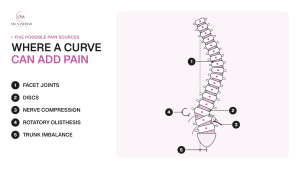
When scoliosis contributes to persistent back pain, the problem may involve the joints, discs, nerves, or muscles. Here are 5 ways that can happen:
- Facet joints: The small joints behind each vertebra may experience uneven pressure, contributing to irritation or arthritis over time.
- Discs: Uneven loading may contribute to disc degeneration. A 2024 review notes that people with adolescent idiopathic scoliosis can develop significant disc degeneration in adulthood.
- Nerve compression: Some lower-back curves are associated with narrowing of the openings where spinal nerves exit (foraminal stenosis), which can cause pain, numbness, or heaviness in the legs.
- Rotatory Holisthesis: In some degenerative curves, a vertebra twists and slips sideways relative to the one below it, potentially compressing a nearby nerve.
- Trunk imbalance: Larger adult curves may shift the trunk sideways or forward, making the back muscles work harder to keep you upright and potentially causing fatigue or pain.
Age matters here too. Scoliosis becomes more common later in life, when degenerative changes may affect the spinal discs and joints. The same 2024 review, by researchers affiliated with Brown University, cites scoliosis estimates of about 8% among adults over 25 and as high as 68% among those over 60, although estimates vary across studies.
Those figures describe how common scoliosis can be, not how many people have pain because of it. That’s why physical therapy treatment for scoliosis should be based on an individual assessment of your symptoms and movement, rather than the spinal curve alone.
How does spinal curvature affect muscle balance and back support?
Spinal curvature can change how your back muscles share the work of keeping you upright. The paraspinal muscles on the outer (convex) and inner (concave) sides of the curve may respond differently, while your deep core muscles help steady your trunk. Here’s how each group contributes to supporting your back:
| Muscle group | What may happen | Why it matters for support |
| Paraspinal muscles on the outer (convex) side | May show greater muscle activity | Help control movement and support the spine |
| Muscles on the inner (concave) side | May show reduced activity or changes in stiffness | Can contribute to differences in how the two sides share muscular support |
| Deep core muscles | Help stabilize the trunk | Work with other muscles to control your trunk as you change positions |
You may feel more discomfort when you stay in the same position for a long time. Do a few hours at your desk leave your back aching for the rest of the day? Sitting for long stretches can tire the muscles supporting your back, especially if you rarely change positions. That fatigue may help explain why your back still feels sore after you get up.
But sitting isn’t the only time your back can feel uncomfortable. Standing in one position for too long may also feel uncomfortable, especially if you tend to keep most of your weight on one hip. You might notice it while waiting in a grocery line or standing at the sink doing dishes, even if walking feels more comfortable.
A few small changes may help with those stretches of sitting and standing:
- Set a 30-minute desk reminder, then stand or walk for a couple of minutes.
- Keep your feet supported and change positions instead of repeatedly leaning on the same armrest or crossing the same leg.
- When standing, try resting one foot on a low step if it feels comfortable, and switch sides as needed.
- During standing chores, take a short walking break if your back starts to feel stiff.
Those adjustments may help with everyday discomfort, but improving strength and control can take more targeted exercise. Physical therapy treatment for scoliosis may include pelvic tilts, bird dogs, planks, and bridges to help strengthen the muscles supporting your spine. A therapist can adjust these exercises to suit your spinal curve and symptoms. During a bird dog, for instance, a therapist can help you keep your pelvis steady instead of letting your hips shift from side to side.
How do you tell scoliosis-related pain apart from other back pain?
Where your back hurts, whether the pain travels into your leg, and what makes it worse can offer clues, but they don’t always tell you whether scoliosis is responsible. Here’s what those symptoms can tell you, and where they overlap:
| Clue | What you might notice | Why it matters |
| Pain location | One-sided pain, sometimes near the main spinal curve | This can happen with scoliosis, but muscle, joint, and disc problems may cause similar pain |
| Leg symptoms | Pain spreading into one leg, sometimes toward the front of the thigh | Pain travelling into the leg may also indicate nerve involvement |
| What makes it worse | Discomfort during prolonged sitting, standing, or walking | The activity that brings on pain may help a clinician investigate its cause |
A 2023 systematic review in the Journal of Clinical Medicine found that adults with scoliosis often reported distributed back pain unevenly, sometimes near the main curve. When pain spread into the leg, front-of-thigh symptoms were reported more often among people with scoliosis than those without it.
Where the pain travels matters, but so does what happens when you walk.
Does a short walk leave you searching for somewhere to sit? If leg pain or heaviness builds while walking but eases when you sit or lean forward, spinal stenosis may be one possible explanation. This happens when narrowing in the spine affects the nerves.
The clinical reference StatPearls describes this pattern as neurogenic claudication. And having scoliosis doesn’t mean every new symptom comes from the curve, since spinal stenosis or a disc problem could also be involved.

When does persistent scoliosis back pain need a professional assessment?
If your scoliosis back pain keeps coming back, isn’t improving after a few weeks, or starts limiting how long you can sit or walk, it’s worth getting assessed. Who you should see first, and how soon, depends on your symptoms.
| Symptoms | Who to see | When |
| Repeated flare-ups or finding it harder to sit or walk for as long as before | A physiotherapist or doctor | Book an appointment soon |
| New or worsening leg weakness, numbness, or foot drop | Urgent medical care | Ideally the same day; seek emergency care for severe or rapidly worsening weakness |
| New difficulty urinating, loss of bladder or bowel control, or numbness around the groin or buttocks | Emergency care | Immediately |
| Back pain with fever, or pain after a significant fall or injury | Urgent medical care | Same day; emergency care after serious trauma |
| Persistent night pain or unexplained weight loss | Your doctor | Arrange an appointment promptly |
If your pain keeps coming back or makes everyday activities harder, scoliosis physiotherapy in Brampton may be a good place to start, as long as you don’t have any of the warning signs above. Before recommending exercises or hands-on treatment, a physiotherapist should review your symptoms, check for warning signs, and refer you for medical assessment if anything raises concern.
Get individualized support for scoliosis-related back pain at Dr. Sandhar Wellness
Knowing how much your spine curves is one thing. Understanding what’s contributing to your back pain helps shape the care you may need. Dr. Sandhar Wellness in Brampton highlights 15 years of experience and offers a free consultation to discuss your symptoms and treatment options.
If you decide to move forward, here’s how the clinic approaches treatment:
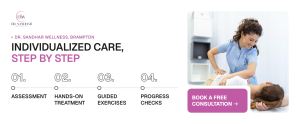
To find out which options may suit your back pain, book your free consultation online and ask about physical therapy treatment for scoliosis.
Frequently Asked Questions (FAQs)
Q1. Does physical therapy straighten a scoliosis curve?
In adults, physical therapy generally doesn’t permanently straighten a structural scoliosis curve. It focuses more on easing pain, improving mobility, and building trunk control, even if your Cobb angle, the curve measurement on an X-ray, doesn’t change much. For teens who are still growing, a spine specialist may recommend monitoring, scoliosis-specific exercises, or bracing depending on the curve and its risk of progression.
Q2. Should you keep exercising when scoliosis pain flares up?
Usually, yes, but choose gentler movements and avoid pushing through worsening pain. Too much rest can leave your back feeling stiffer, while gentle movement may help ease the discomfort. You could try short walks, pelvic tilts, or cat-cow stretches if those movements feel comfortable and suit your care plan. If an exercise causes new or worsening pain down your leg, stop and get advice before continuing.
Pain that keeps getting worse or doesn’t settle also deserves a medical assessment. New or worsening leg weakness needs urgent attention, while new numbness around your groin or changes in bladder or bowel control mean going to an emergency department immediately.
Q3. Can you do physical therapy for scoliosis at home?
Yes, but it’s best to have a physical therapist assess your condition before you start. Not every scoliosis exercise is suitable for every curve pattern or set of symptoms. A physical therapist can show you which exercises to do at home, how often to perform them, and how to adjust them if they cause discomfort.
Q4. How soon will physical therapy ease scoliosis back pain?
Some people notice less discomfort within the first few visits, while others need more time to feel a difference. Your symptoms, treatment goals, and response to therapy all affect the timeline. You might first notice that you can sit or walk longer before your back starts aching. Keeping up with your prescribed home exercises can help you build on that progress between appointments.