
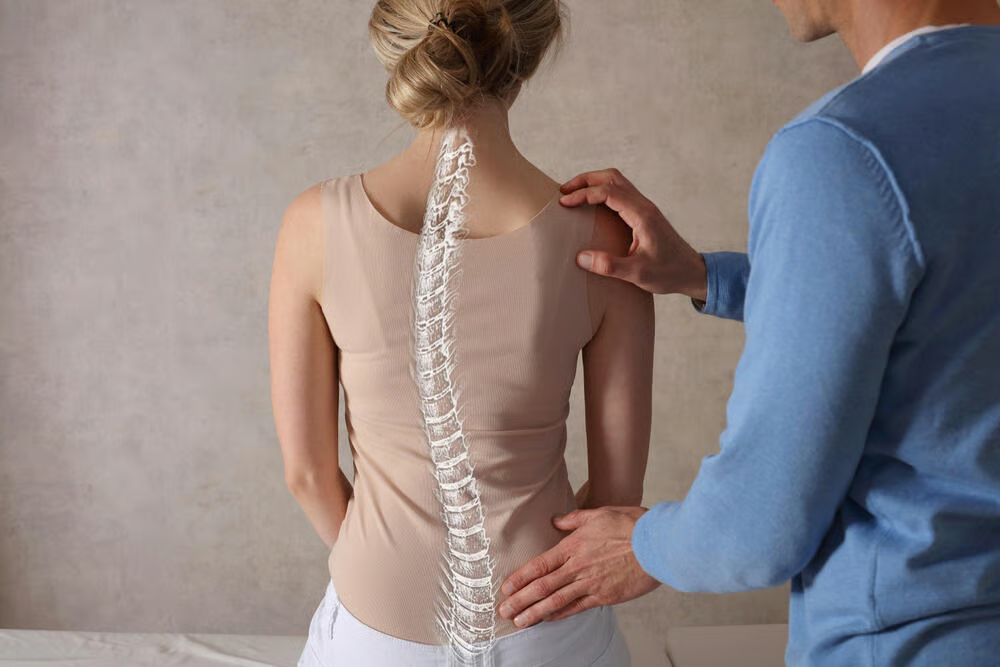
Have you ever noticed that one shirt strap keeps slipping off your shoulder or that a hem always seems to hang a little crooked? It could be the way your clothes fit or how you’re standing. But when you keep noticing the same difference, it’s easy to wonder, “Is this just how my body sits or should I get it checked?”
Scoliosis can affect children, teenagers and adults and it doesn’t always cause pain or obvious problems at first. Sometimes… The first thing a parent notices is a shoulder sitting higher than the other. In adults, it might be a change in posture, stiffness or a curve that becomes more noticeable over time. These signs don’t automatically mean scoliosis, but it’s worth asking a professional if the changes persist.
In this guide, we’ll look at the early signs to watch for, why scoliosis develops, how it’s checked and what a diagnosis might mean. You’ll also learn why uneven shoulders don’t always point to a spinal condition and what steps you can take if something about your posture has caught your attention.
What Is Scoliosis?
Scoliosis is a sideways curve of the spine that may also involve a twist in the vertebrae. Doctors generally use the term when a curve measures 10 degrees or more on a standing X-ray. Smaller curves are usually called spinal asymmetry.
The curve can look more like a “C” or an “S,” depending on where it forms and whether there is more than one curve. It may affect the upper or lower part of the spine and the turning of the vertebrae can make one side of the ribs or back look more prominent. That is why a person may notice a change in the shape of their back, not just their posture from the front.
Scoliosis can develop during childhood or adolescence or become noticeable later in life. Adolescent idiopathic scoliosis is the most common form and affects 2 to 3% of adolescents. In adults, a curve may be linked to age-related changes in the spine or one that started years earlier.
A curve doesn’t automatically mean pain, major problems or treatment. Some stay small and simply need monitoring; others need closer attention, especially if a child is still growing. A mirror can only show so much… a healthcare professional can help work out whether a curve is present and what to do next.
What Causes Scoliosis?
Sometimes, the reason for scoliosis is clear. Other times, it isn’t. Many cases in children and teenagers have no known cause and scoliosis isn’t caused by poor posture or carrying a heavy backpack. If you’re a parent, please don’t blame yourself… this usually isn’t something you could have prevented. Doctors usually group scoliosis into 4 main types:
- Idiopathic scoliosis: “Idiopathic” is a medical way of saying the cause isn’t known. It’s the most common type diagnosed during adolescence. Adolescent cases make up roughly 80 to 85% of idiopathic scoliosis. It can run in families, so family history may be worth mentioning at an appointment, but there isn’t one particular habit or activity to blame.
- Congenital scoliosis: This is when the bones of the spine don’t develop properly before you were born. The curve may not form properly or may fuse together in some vertebrae, and may become more noticeable as the child grows up. The curve may not appear at once, particularly if it is a slight curve at the beginning.
- Neuromuscular scoliosis: This type may be connected with problems with the nerves or muscles that support your spine. If those systems work differently, the spine may not get the same balance and support and a curve can develop. Treatment often depends on the underlying condition and the curve itself.
- Adult-onset or degenerative scoliosis: Adult-onset or degenerative scoliosis: This may develop or worsen as spinal discs, joints and other structures change with age. If those parts wear unevenly the spine can slowly curve to one side. Symptoms can vary between people but people may notice stiffness, changes in posture or back pain.
When Do Early Signs of Scoliosis Usually Appear?
Scoliosis can show up at different ages and the first clues aren’t always obvious. Many children and teenagers don’t feel pain, so there may be nothing to alert them that something has changed. You might notice the difference when helping a child get dressed, looking at their back in a swimsuit or seeing that a waistband no longer sits evenly. The signs can look a little different depending on a person’s age:
- During childhood: You might notice that a child’s clothes hang unevenly, one shoulder sits higher than the other or one hip looks more prominent. They may feel completely fine, so don’t expect pain to be the first clue. If you keep seeing the same differences, mention them at a routine medical appointment.
- During adolescence: Changes can become easier to spot during a growth spurt. As the body grows, the shirt, swimsuit or waistband might suddenly fit differently. One shoulder blade or rib side might also protrude more than the other, particularly when bending forward, as the teen does.
- In adulthood: A curve may be visible due to development or due to the growth of an already existing curve. Some adults also experience stiffness or back discomfort, although these symptoms can have many causes. In one study of healthy volunteers over 60, 68% met the X-ray definition of scoliosis, although many had no marked impairment.
- At any age: Uneven shoulders, one shoulder blade sticking out, an uneven waist, one hip sitting higher or one side of the back sitting higher when bending forward are all worth discussing with a healthcare professional. They don’t automatically mean scoliosis… some people naturally have asymmetry and a professional can help tell the difference.
How Is Scoliosis Diagnosed?
A healthcare professional will usually ask about your health, look at your posture and examine your spine. They may ask you to bend forward and, if needed, recommend an X-ray. A photo or mirror might help you spot a change, but it can’t tell you whether you have scoliosis… that takes a proper assessment. The various components of the check provide the clinician with different information, so here’s what it might entail:
- Medical history: Questions will be asked about symptoms, growth, family health history and other health issues. If a parent or sibling has scoliosis, mention it… it can help the clinician understand your background. They’ll also want to know when you first noticed the change and whether it seems to be getting more obvious.
- Physical examination: Clinician observes standing posture in natural standing position. They will also check to see if your head is held over your pelvis, and if your hips are at a level. This allows them to determine if the difference may be due to posture or they should investigate further.
- Spinal assessment: The clinician might ask you to bend forward and check for any differences or tilts along your spine or ribs. This is sometimes referred to as a “forward bend exercise”. It may highlight some differences, but is not enough to diagnose scoliosis.
- X-rays when needed: When appropriate, X-ray helps to confirm the diagnosis of scoliosis and determine the size of the curve. It can also show where the curve sits in the spine. Not everyone with uneven shoulders needs one. The U.S. Preventive Services Task Force found insufficient evidence to recommend routine scoliosis screening for adolescents.
- Cobb angle measurement: If an X-ray is taken, the Cobb angle is used to measure the curve. That number helps guide care, but it isn’t the whole story. Your age, remaining growth, symptoms, curve location and whether the curve changes over time all matter too.
Can Scoliosis Cause Back Pain or Other Symptoms?
Most children and teens with scoliosis don’t experience any real pain, particularly if the curve is not very severe. Sometimes, all they need to do is show a different posture or clothes no longer fit the same. These changes may not be noticed by the child, but rather by a parent or health care professional.
Back pain or stiffness may occur in adults also, especially if they are suffering from age-related changes to the backbone. In one study of symptomatic degenerative scoliosis, 60-80% complained of back pain. However, it is not always scoliosis that is the cause of pain. Pain in the back is a very common condition that can be caused by a variety of conditions so it is important to not assume that the spinal curve is the cause of all symptoms. The potential impacts are:
- Changes in body balance: Your shoulders, waist or hips may look as though they don’t line up evenly. You might notice one hip looks more prominent or your clothes sit differently, even if nothing hurts. Some people notice these changes in photos before they notice them day to day.
- Movement difficulties: Stiffness or some difficulty with certain movements, particularly after sitting or standing for extended periods of time. Others see little change in their lives. This is dependent on the curve, and any changes that have occurred in the spine as well as the overall health of the individual.
- Back discomfort: Pain can happen, but it isn’t always caused by scoliosis. If it’s severe, unusual, persistent or getting worse, get it checked rather than trying to work out the cause yourself. If you have back pain and experience numbness, weakness or other new symptoms, you should seek medical attention. A chiropractic and physiotherapy evaluation for back pain may be useful to delve into symptoms and possible causes.
- Breathing difficulties in severe cases: A large curve may decrease chest room and make breathing more difficult. This is a concern with some severe curves, not something most people with mild scoliosis experience. New or unexplained breathing difficulty should always be assessed by a medical professional.
What Is the Difference Between Normal Postural Asymmetry and Scoliosis?
One shoulder sitting higher than the other doesn’t automatically mean scoliosis. The way you stand, your natural body shape and other factors can affect how your posture looks. Sometimes, a difference changes when you shift position; a structural spinal curve needs a more careful assessment. The comparison below explains some common differences, but it isn’t a way to diagnose yourself… the two can look similar from the outside.
| Comparison factor | Normal postural asymmetry | Scoliosis |
| What it is | A visible difference in body position or symmetry that can have several explanations. Curves under 10 degrees on an X-ray are generally called spinal asymmetry. | A spinal condition involving a sideways curve that may also include rotation of the vertebrae. |
| Shoulder height | Shoulders may look uneven because of positioning or other factors. | Uneven shoulders can be one visible sign. |
| Waist or hip appearance | Differences may relate to posture, natural body shape or other factors. | An uneven waist or hip appearance can occur with a spinal curve. |
| Rib or back prominence | The way someone stands can change how their back looks. | One side of the back or ribs may look more prominent, especially during a forward-bend examination. |
| Spinal curvature | Visible asymmetry doesn’t necessarily mean structural scoliosis is present. | A professional assesses the spinal curve to determine whether scoliosis is present. |
| Possible causes | May relate to positioning, natural body variation or other conditions. | Can be idiopathic, congenital, neuromuscular or degenerative. |
| Changes with position | Some visible differences may change when a person adjusts their position. | A structural curve may remain evident, although its appearance can vary with position. |
| Assessment method | The assessment depends on the suspected cause and any symptoms. | A clinical examination and, when needed, X-rays can help confirm and measure the curve. |
| Pain or discomfort | May or may not be present. | Pain can occur, but many children and teenagers have little or no significant pain. |
| Management | May not need treatment or care may help if a contributing factor is found. | Depends on curve severity, age, remaining growth, symptoms and risk of progression. |
What Should You Consider After a Scoliosis Diagnosis?
Getting a scoliosis diagnosis can be scary, but it doesn’t automatically spell out a death sentence or mean you’ll need surgery or extensive treatment. It is contingent upon the curve . Your age . Are you still growing? The chance that the curve will get worse. Your clinician should explain what those details mean for you and how often the curve needs to be checked. These are useful things to ask about:
- Age and remaining growth: Children and teenagers who are still growing may need closer monitoring because a curve can progress during that time. Once growth is complete, the risk can change depending on the curve and other factors. That’s one reason age is an important part of the treatment plan.
- Curve severity: Curve size helps to make decisions. A small curve that is not changing may need to be treated differently than a larger advancing one. The location of the curve can also influence the advice a clinician gives.
- Symptoms and daily life: If pain, stiffness, or trouble moving is interfering with your day, let your clinician know. Tell us about any activities that are difficult for you, if your symptoms change during the day and what helps or makes them worse. What you can do comfortably is as important as what the X-ray shows.
- Risk of progression: Age, remaining growth, curve characteristics and changes over time all help determine how closely the curve should be monitored. One appointment may not tell the whole story, so your clinician may compare later examinations or X-rays with earlier results.
- Observation and monitoring: Some curves only need regular check-ups, with imaging when appropriate. Monitoring is still a plan… it lets your clinician look for changes and respond if needed. Ask how often you should come back and which changes you should report between visits.
- Bracing for suitable growing patients: Some children and teenagers may be offered a brace to help reduce the risk of the curve progressing. A brace isn’t right for every person and it generally aims to stop a curve from getting worse rather than instantly straighten the spine. In the BrAIST trial, treatment success was 72% with bracing compared with 48% with observation. Wearing the brace for more hours was linked to better results.
- Scoliosis-specific exercises: An individualized exercise program can be beneficial in maintaining posture, building strength and supporting movement and symptom control. Exercises need to be adjusted to the person’s needs and be part of a care plan. Low-quality evidence for exercises as an adjunct treatment, therefore, should not be used instead of appropriate medical monitoring, according to a Cochrane Review.
- Specialist evaluation: Larger, progressing or complex curves may need a specialist’s input. Ask why a particular option is being recommended, what it is expected to do and what alternatives are available. Bracing or surgery isn’t necessary for everyone, so it’s reasonable to ask questions before making a decision.
Where Can You Get Professional Scoliosis Assessment?
If you have observed any changes in your posture or back, then Dr Sandhar Wellness provides you with physiotherapy and chiropractic care services that include physiotherapy treatment for scoliosis. Depending on the needs, corrective exercises and manual therapy, such as joint mobilization or soft tissue release may be involved. Your posture and spinal alignment, muscle balance and mobility are examined during an assessment to help the team determine if you may need support.
You can discuss what you’ve observed, describe symptoms and discuss what kind of support might be available for your daily movements and comfort. Physical therapy can be used for strengthening, mobility and everyday function and symptom management, where appropriate. A posture assessment can also help explore whether a visible difference needs further attention.
One important point: suspected scoliosis may need medical evaluation, imaging or a specialist’s opinion. If that’s the case, a clinician can guide you toward your family doctor or an appropriate specialist. Not every clinic diagnoses scoliosis or interprets X-rays, so ask what the clinic can assess before deciding on your next step.
Book a Consultation to Discuss Scoliosis Warning Signs
If a shoulder, waistline or shoulder blade keeps catching your eye, it’s worth wondering whether the difference means something. It may turn out to be harmless, but getting the right guidance can help you stop assuming and understand whether anything needs attention.
At Dr Sandhar Wellness, we provide physiotherapy and chiropractic care to support posture, mobility and movement-related concerns. Through assessments and personalized care, we help you understand which support options may suit your needs.
Stop wondering and take the first step toward getting answers. Book your free consultation with Dr Sandhar Wellness to discuss the changes you’ve noticed and find out what to do next. You don’t need to figure everything out before reaching out… share your concerns with us and we’ll help you understand the next steps.
Frequently Asked Question (FAQs)
Q1. What are the first warning signs of scoliosis?
Some early signs are uneven shoulders, uneven waist, one shoulder blade sticking out more or one side of the back sitting higher when you bend forward. Clothes may also appear to hang unevenly. These changes are worth investigating but do not prove scoliosis.
Q2. Can scoliosis develop in adulthood?
Yeah. In adult scoliosis, the spine can develop degenerative changes due to age or the pre-existing curve may worsen. They can also have other causes, though. You may feel stiffness or discomfort in your back.
Q3. Can scoliosis cause back pain?
May be, particularly in the elderly who have age-related spinal changes or in youngsters with spinal deformities. However, pain is not often experienced by many children and teens with mild curves. If your backache persists or becomes more severe, or you develop new weakness or numbness in your back, see your doctor.
Q4. How is scoliosis diagnosed?
Your health professional will examine your posture and spine and ask you some questions about your medical history. They might suggest an X-ray if indicated to check for scoliosis, bend forward and may suggest that if the curve is found in an X-ray, monitoring or treatment might be necessary.